
Where Buildings Blossom With Confidence
Custom Wood Doors for a Canadian Client: Frames, Finishes and Installation Support

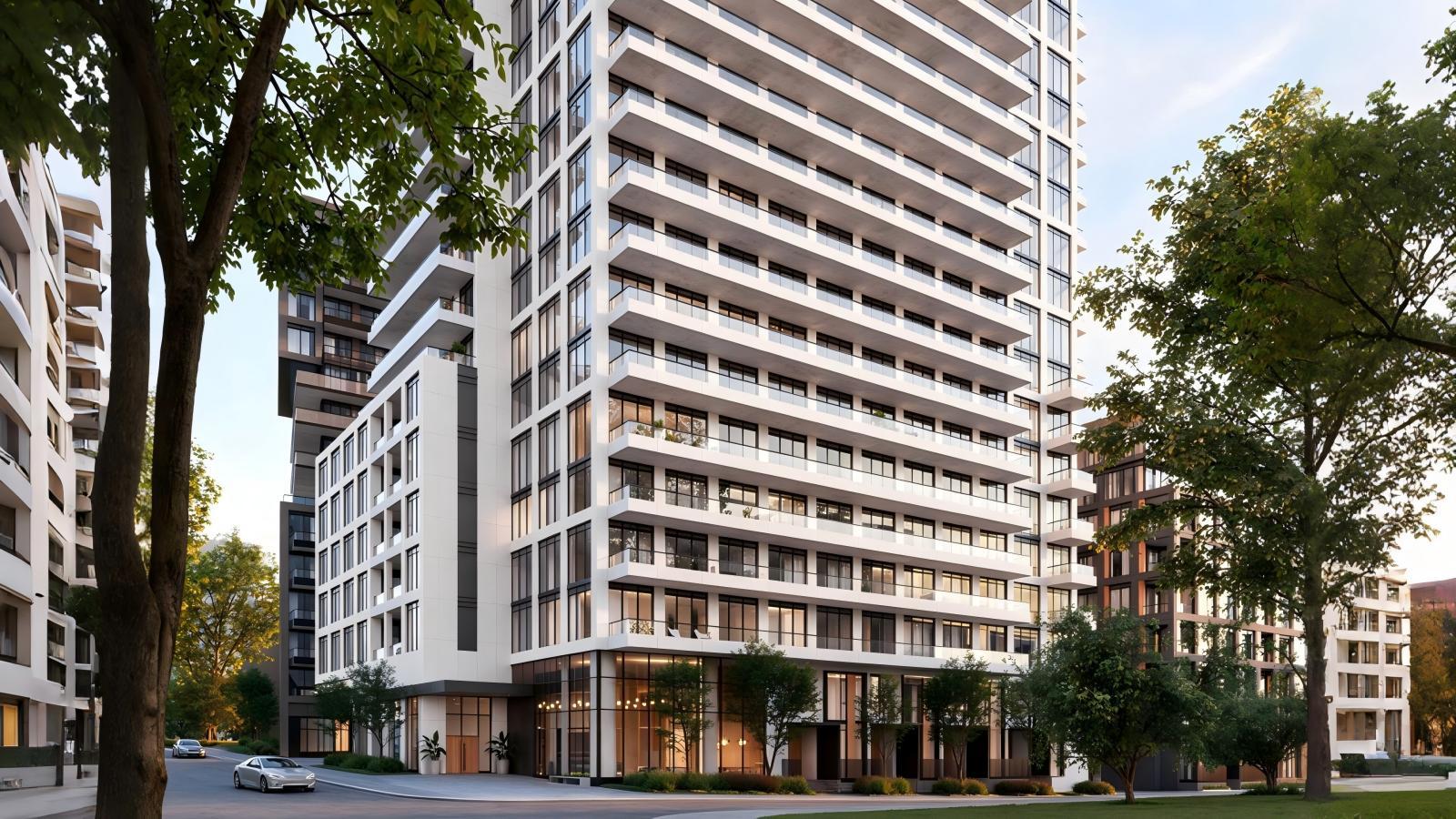
A Metro Vancouver builder walked into our workshop on the strength of a referral. What he needed was not a beautiful door but a complete package that could survive a Canadian site: eco interior doors, eco entry wooden doors, locks, hinges and packaging.
Quick Answer
A builder in North Vancouver, Canada — referred by a long-standing client — handed one supplier the full package: 550 sets of eco interior and entry doors, locks, hinges and branded packaging for a model building. Lacquer-free melamine faces, graphene cores, pre-installed single leaves, and a Christmas deadline met by finishing production and loading in seven days.
-
Eco rests on four proofs: a formaldehyde report, a lacquer-free face, a graphene core, factory pre-installation.
-
Single leaves ship 100% pre-installed; double leaves are assembled on site by design.
-
The carton is the manual: storage rules, installation QR, warranty and after-sales path.
| Aspect | Details |
|---|---|
| Client Code | C00061514 |
| Project Type | Commercial |
| Solutions | Eco interior and entry wooden doors, door frames, locks, hinges and branded packaging |
| Quantity | 550 sets |
| Address | North Vancouver, British Columbia, Canada |
What Did This Builder Actually Order?
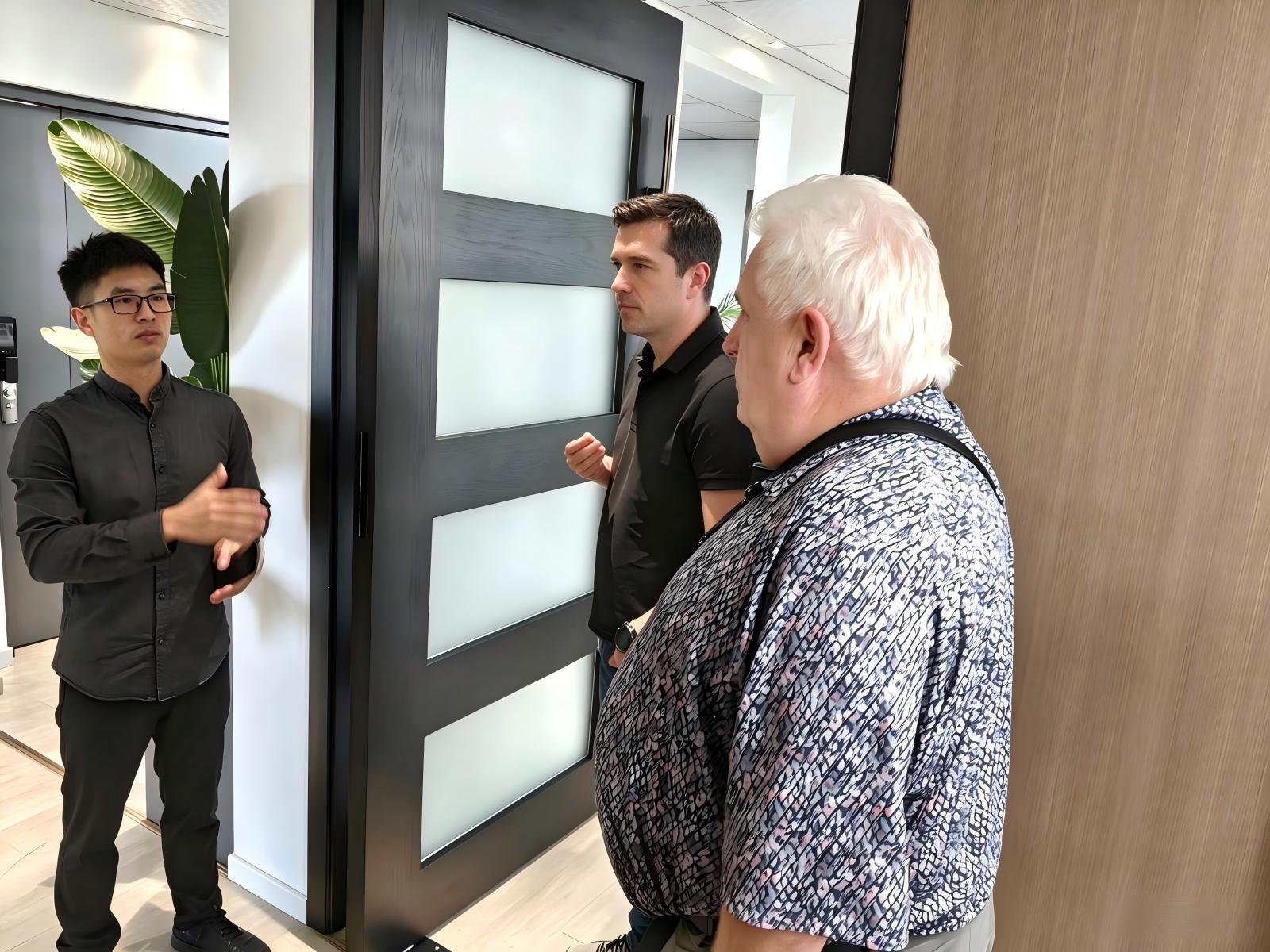
He is a well-known builder operating in North Vancouver, British Columbia, introduced by a long-standing client of ours who had already delivered several projects with us. The introduction landed during his first trip to China: he was in Foshan looking at an unrelated industry, and once our name came up he changed his schedule and came to the workshop the same day.
That afternoon he and his Chinese wife went through production details, process flow and samples. Half a day was not enough, so they came back the next morning. A builder with decades behind him does not judge a supplier by the pitch; he reads the sequence inside the workshop — how material enters, how slabs are stacked, how bores are cut, how cartons are sealed.

The order was 550 sets for the project’s model building, split into four parts: eco interior doors for units and residential rooms; eco entry wooden doors for the entrance and corridor interface; the locks and hinges that go with them; and packaging printed with brand and service information. All four had to hold at the same time. If one fails, the site gains a rework step — and that rework lands on the supplier’s account.
His buying habits were just as clear. He does not fear problems; he fears a mismatch. Once the price is agreed he does not renegotiate, and he pays as agreed. This kind of buyer puts risk into the conversation up front and puts execution under observation afterwards. For us it means the clarification phase has to be complete, because there is no second chance to explain.
| Dimension | Typical local supply | This project’s requirement | What we did |
|---|---|---|---|
| Price structure | Cheap timber, expensive finished doors; labour and finishing lift the unit price | Multi-unit, phased construction with a project-level budget | Doors, hardware and packaging quoted as one package, price locked to approved drawings |
| Structural customisation | Catalogue series with limited deviation | Acoustic, thermal, flatness and frame depth differ room by room | Door-by-door detailing, identical specs batched |
| Lead time | Long scheduling, uncertain milestones | Must line up with construction phases | 25–35 days from approval; 7–10 day express for critical items |
| Hardware and installation | Hardware bought separately, bored on site | Expensive site labour, costly rework | Locks and hinges bored, fitted and adjusted before dispatch; handles packed separately |
| Packaging and identification | Generic cartons with little information | Several buildings and batches with near-identical specs | Branded carton with storage rules, installation QR, warranty and after-sales path |
| Eco documentation | Submittable formaldehyde and restricted-substance documents | Reports travel with the batch, numbers traceable | Submitted, submittable |
Why Would a Canadian Builder Import Eco Doors From China?
Canada is not short of timber; the cost sits in the finished product. Local lumber is cheap, finished doors are not: labour, finishing, drying and scheduling push the unit price up, and the fit with apartment budgets is limited. This is a cost-structure gap, not a quality gap.
So his first requirement was not “cheaper” but “a closer fit”: structures changeable room by room, frames adjustable to wall build-ups, batches split to match construction phases. A catalogue range rarely delivers all three; in custom manufacturing they are routine.
The second requirement was delivery mechanics. He worried about freight, packaging and installation. We took all three off his desk in advance — one-stop freight, installation guidance printed on the carton, and pre-installation included in the first cooperation, moving his most expensive Canadian labour from the site back into the plant.
None of this was our own claim. He had seen the referrer’s finished projects, and his wife was at home with how Chinese factories communicate. Together they shortened his question from “should we try” to “when do we try” — the only part of this order we would call luck.
There is a practical layer too: until doors arrive, trims, hardware, touch-up and cleaning cannot close out. For him, lead time is site cash flow.
What Does “Eco” Have to Mean on a Door Specification?
An eco door is not a door that merely smells acceptable. On this order it broke into four checkable things: formaldehyde release from board and adhesive; the finish, or the decision to have none; the stability of the core and transition layers; and the site pollution removed by factory pre-assembly. Leave any one unexplained and “eco” collapses back into an adjective. our eco manufacturing capability
The build-up on this batch: a melamine face, a carbon-crystal transition layer, a graphene-filled core, and a solid blockboard frame wrapped in HPL. The graphene core answers the conflict between leaf weight and long-term stability; the carbon-crystal layer separates skin from core and absorbs stress at the face. The layers stay separable instead of being pressed into one board.
Formaldehyde on this batch is documented: the report was produced against the board and adhesive actually used and travels with the batch. North American teams usually benchmark to TSCA Title VI and CARB Phase 2 and European teams to EN 717-1; the file names differ, but a clear, traceable formaldehyde report is accepted on both sides, which is why it belongs in a case study. The wooden door range also holds a RoHS test report under the CE framework, ROHS-ATL202501241570, dated February 2025, restricting lead, mercury, cadmium, hexavalent chromium and PBB/PBDE flame retardants. It covers the parts that actually touch chemicals: electronic lock modules, adhesives and surface treatments. What it proves is not formaldehyde compliance but the absence of heavy metals and flame retardants that should not be in a door — two claims that are routinely confused.
On finish, this batch’s answer is “no finish”. The skin is a lacquer-free melamine HPL: no water-based paint line, no UV line, so the plant has no solvent-emitting step and the site needs no touch-up spraying. That is more thorough than low-VOC paint — the source is removed, not reduced. It is not a narrower colour choice, though. Colour comes from the film, and the film range is a wide system in its own right — woodgrains and solid tones together — so a project can pick its entire palette from it and nobody chooses less because the door is lacquer-free. The one thing it cannot do is tint to an arbitrary reference on the spot, or stain on site. Colour is therefore fixed at detailing, and every batch afterwards comes off the same film, which makes batch-to-batch variation more controllable than painted colour, not less.
The site half of eco sits in the installation method: every single leaf ships pre-installed, while double leaves, limited by size and hinge alignment, are assembled on site. Most doors inside a unit therefore arrive finished and generate no boring dust; only the large double leaves need site work. The cost is not money, it is that the factory must hold confirmed opening sizes early.
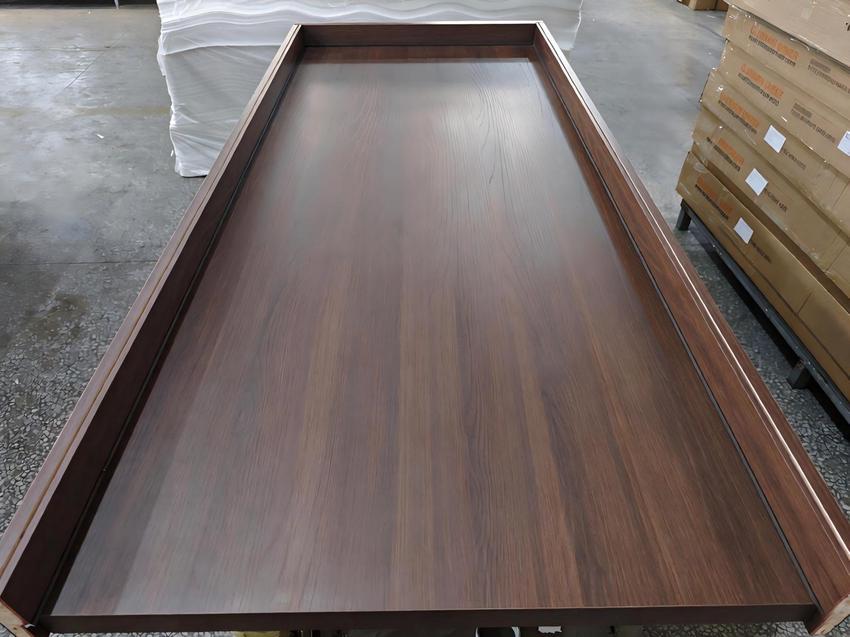
| Eco factor | Common project threshold | How we document it | Status on this order |
|---|---|---|---|
| Board formaldehyde | TSCA Title VI, CARB Phase 2; EN 717-1 for European specs | Emission test on the board and adhesive actually used; report travels with the batch | submitted |
| Finish choice | Lacquer-free or low-VOC system with testable documents | Face system and batch records, with no solvent step | lacquer-free |
| Core and transition | Balance between leaf weight and stability, no long-term distortion | Layer-stack specification and core configuration | graphene core + carbon crystal |
| Site pollution | Fewer site bores, cuts and spraying | Pre-install scope and packaging recovery list | single pre-installed, double on site |
| Restricted substances (RoHS) | RoHS limits under CE: lead, mercury, cadmium, Cr(VI), PBB/PBDE | Report number and date, submittable with the tender pack | on file |
| Timber sourcing | Legal sourcing; some projects require FSC | Sourcing statement and chain-of-custody documents | statement provided, requirement met |
The table is also how we test whether eco is real: by whether the factory will move work off the site and into the plant. If it will not, eco stays on the brochure.
Interior Doors and Entry Doors: Where the Specification Split
Interior and entry doors come out of the same wooden door system, yet they travel two different paths on a drawing set. Interior doors serve the interface between rooms; entry doors serve the interface between the building and the street. Load paths, hardware and tolerance are entirely different. Our wooden door systems are built as a disassemblable structure precisely so both paths can be walked.
Structure: flatness, mass and frame depth
For interior doors the first metrics are flatness and quiet: slab flatness sets how the finish reads under light, and structural rigidity sets both the closing feel and the acoustic base. For entry doors the metrics are stability and defence: a heavier leaf, hinges that survive traffic, a denser lock body, and a clean junction between frame and exterior wall. The real risk in one factory building both is applying interior-door thinking to an entry door.
Swing, frame depth and the opening
Swing direction is never an aesthetic choice. A narrow corridor, a cabinet behind the door, or egress clearance at a unit entrance all move the hinge position and the opening angle. Frame depth follows the wall: different floors and different partitions in the same building can need different depths. Parameters as basic as door and window opening directions are exactly what gets skipped in detailing and amplified on site.
Colour and style: choosing a project language, not a swatch
The project settled on a neutral, low-saturation wood grain that reads correctly against both the apartment’s public interface and the unit interior. Style was handled by subtraction: fewer slab divisions mean easier factory consistency and less “door sorting” on site. In this context door and window colour range and door and window styles are not decorative options; they are variables in the probability of rework.
We fixed both variables inside one shop-drawing set: a single door had to point to the same numbers on plan, elevation and hardware drilling sheet. Otherwise the factory builds it right, the site installs it wrong, and the liability still lands on the supply chain — the most common and least deserved failure in this trade.
Where Is the Real Cost in Locks, Hinges and Pre-Installation?
In Canada, labour is the least stable component of a door’s cost. Moving work back into the plant converts uncertain site labour into a fixed manufacturing hour. The value of smart manufacturing is not attractive machinery; it is that bores, clearances and finishes repeat across a batch.
Lock handling is concrete. Lock body, cylinder and faceplate bores are cut in the factory to the chosen hardware model; the lock is assembled and adjusted; handles ship separately, unmounted. A knocked handle no longer scraps a whole leaf in transit, and the site never stalls a floor over one missing handle.
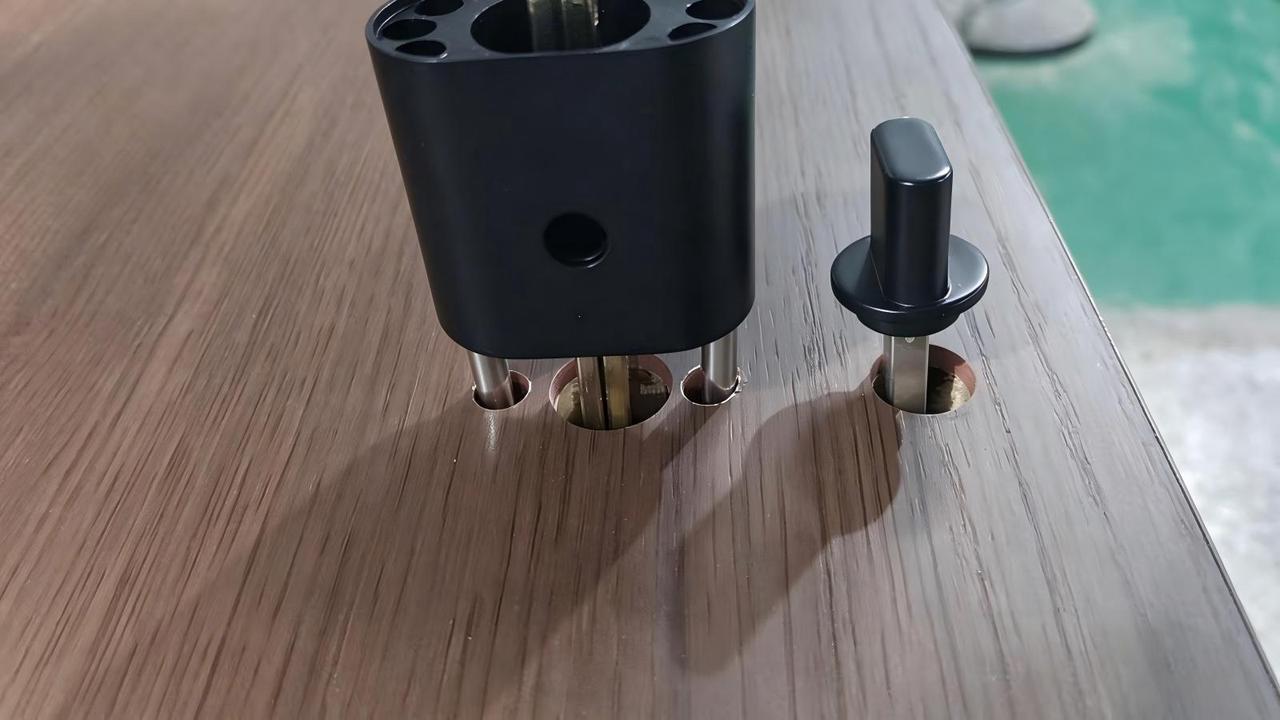
Hinges are the other skipped point. Entry leaf weight, unit traffic and leaf-to-frame clearance all load the hinge. Setting clearance before dispatch leaves only fine adjustment on site, and the door does not start dropping three months later. This fault never shows in week one; it shows at the first complaint.
The scope here was drawn as a line: every single leaf shipped 100% pre-installed — bores, lock body, faceplate and hinge spacing done in the plant. Double leaves were not, because two leaves of that weight need hinge alignment against the real opening, and forcing it turns one factory tolerance into two site errors. On a first cooperation we included this as a term of the relationship, not a discount. Our installation guidance shows the method.
Pre-installation is not universal: it pays in expensive-labour markets and may not in cheap ones. There is one test: is this hour of work cheaper and more consistent in the plant than on site? If both answers are yes, move it; if one is no, leave it on site. That test is more reliable than any sentence about good service.
Why Did Packaging and Loading Decide the Site Outcome?
On a project order the carton is documentation, and the terms on it are quotable: quote, contract, drawings and service aligned as one, traceable production progress, transparent shipping cost, then storage rules, QR-linked installation guides and the after-sales path. Warranty and incentive sit on our quality incentive terms page, service timelines on our delivery protocol page. Carton space given, site time returned.
Why does print deserve that space? This project shipped across several buildings and batches with near-identical specifications. A misread carton puts the wrong door on the wrong floor; an unwatched clip gets a hinge over-torqued. Packaging never clocks off.
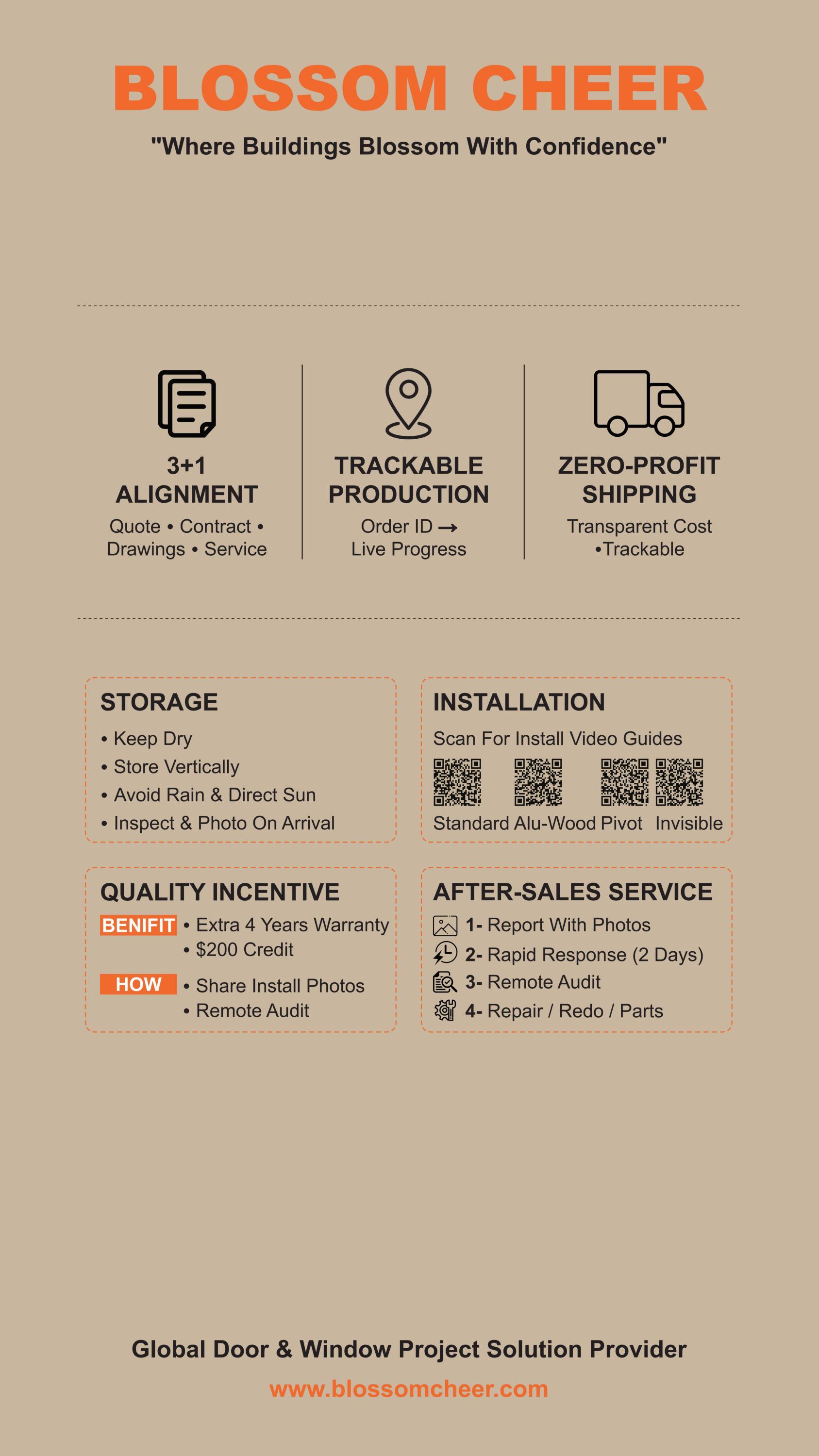
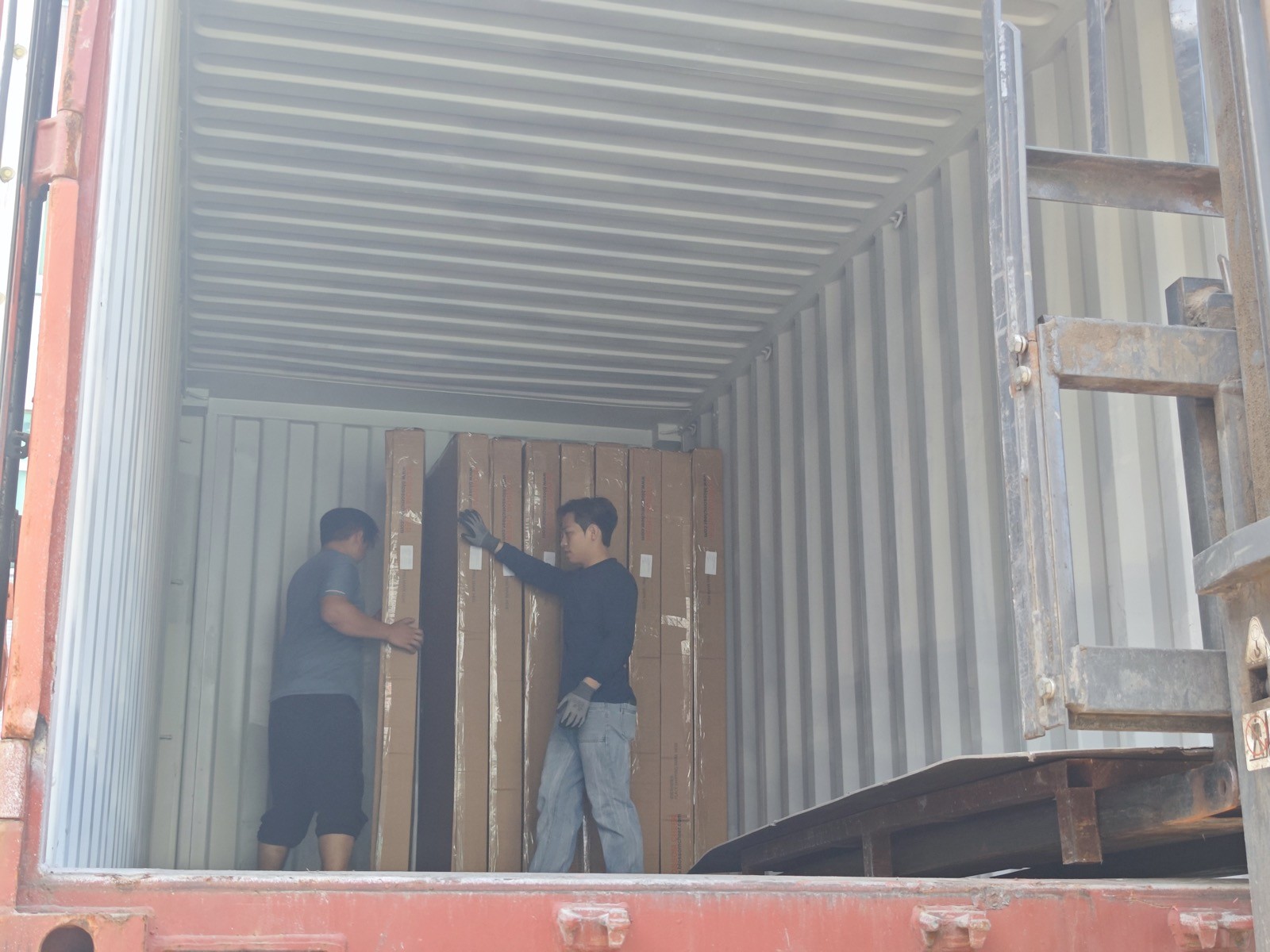
Loading is a quality operation, not a logistics one. Leaves stand vertically, are braced piece by piece, stacked in drawing order, weighed and measured with records kept, then sealed with a recorded container number. Those records remove the room for a “one piece short” or “corner hit” argument before it can start. The value of order fulfilment lives in exactly the steps nobody wants to photograph.
What tested the mechanism was the date. On arrival the client named his one deadline: doors installed on site before Christmas. On a normal schedule we were more than two weeks short; production and loading were finished in seven days, the container sailed on 4 November on a fast vessel, and the sea leg runs about fifteen days direct. A standard order still ships 25–35 days after approved drawings, with a 7–10 day rapid delivery route for tight milestones — this time seven days was the outcome, not the promise.

The client’s message that day was short: “Thank you, it was good to see you again, looking forward to my delivery.” Ours said the schedule had been pulled forward, every milestone would be reported, and freight figures would come that day or the next. This is not a testimonial; it is a record of a working method. If a date is given, the date is where we appear.
FAQ
Can you supply eco doors that satisfy North American
formaldehyde requirements?
Yes. We test emission on the board and adhesive actually used, and the report travels with the batch. North American benchmarks are usually TSCA Title VI and CARB Phase 2; European projects cite EN 717-1. This batch was submitted and accepted in both markets. Send the specification: if it matches we build to it, if not we say so.
Do you pre-install locks and hinges?
On single leaves, yes — 100%pre-installed on this order: bores, lock body, faceplate and hinge spacing set in the plant, handles packed separately, the site fine-tuning only. Double leaves are not pre-installed; their weight and alignment have to be set against the real opening. We treat this as a way to lower trial-order risk, not as a standard feature.
How do you handle walls of different thickness in
the same building?
We detail per opening: frame depths and trims are grouped by measured wall build-up, identical specs are batched, and every number is mapped to a floor before dispatch. The site then needs no second cut, and a floor never ends up with visibly mismatched frame depths.
What is a sensible first order for a builder we have
not worked with?
We usually suggest one unit or one floor first, to validate drawings, carton identification and installation rhythm before scaling. The value of a first order is not margin; it is exposing both sides’ errors at the cheapest stage.
Can packaging carry our brand and installation
guidance?
Yes. Brand, storage rules, installation QR codes, warranty and the after-sales path are printed on the carton, and project-specific floor and batch marks can be added. On a multi-building project the saving is not the printing cost; it is the time spent hunting for the right door.
Case Outline
Contact Us For Your Inquire Door Window Project
Take 1 minute to send your needs to us, we'll make the proposal to you.